
If you’re targeting NEET 2026 and have six months left, this roadmap turns overwhelm into action. Begin with a diagnosis, move into focused revision of high-yield topics, and build stamina with timed mocks. This plan balances study, practice, and recovery so you improve steadily without burning out. Follow the weekly cycles, habit hacks, and test routines to convert hard work into predictable results.
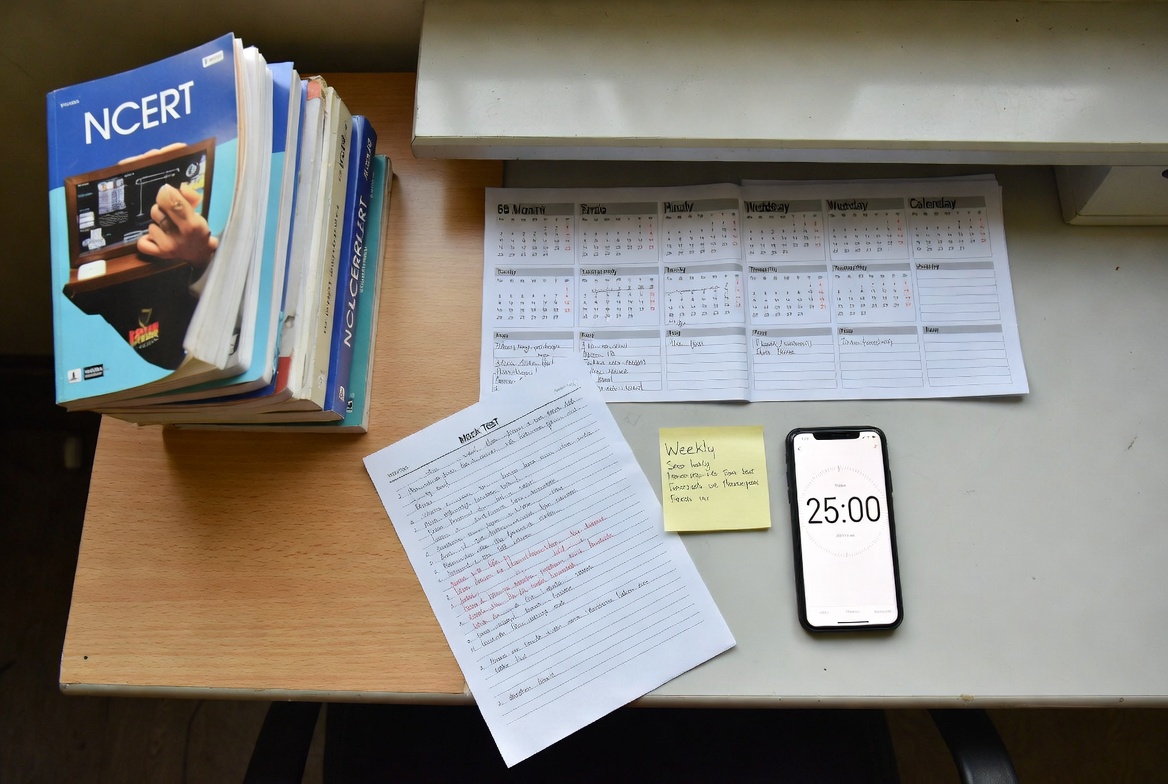
Quick diagnostic: where do you stand right now?
First, take a full-length timed mock to assess strengths and weaknesses. Note:
-
Accuracy by subject.
-
Time lost on calculations.
-
Topics causing repeated errors.
After this, create a personalised priority list. This targeted start makes the NEET 2026 plan efficient.
Month-wise high-level roadmap (6 months overview)
Month 1 — Audit and Core Revision:
-
Finish NCERT reading for weak chapters.
-
Make one-page notes and diagrams.
Month 2 — Concept Reinforcement:
-
Solve topic-wise practice sets.
-
Start a mistake log.
Month 3 — Speed & Application:
-
Timed topic tests.
-
Begin mixed subject practice.
Month 4 — Full-Length Mocks:
-
One full mock weekly; detailed analysis.
Month 5 — Intensive Revision:
-
Revise mistake log and one-page notes.
-
Focus on high-yield Class 11 and 12 overlap topics.
Month 6 — Exam Readiness:
-
Daily short mocks, formula blitz, and mental conditioning.
This sequence keeps momentum and steadily raises performance.
Prioritise high-yield NEET 2026 topics
Focus on topics that appear frequently:
-
Biology: Genetics, Human Physiology, Ecology.
-
Chemistry: Organic reactions, Stoichiometry, Chemical Bonding.
-
Physics: Mechanics, Electricity, Optics.
Concentrate early on high-yield areas and keep revisiting them.
Weekly routine that scales over six months
Adopt a repeatable weekly template:
-
Two concept days (deep work on new/weak topics).
-
Two practice days (topic sets and problem solving).
-
One timed mixed session (60–90 minutes).
-
One full revision day (flashcards, diagrams).
-
One rest or light review day.
This structure balances learning and consolidation.
Daily micro-schedule (sample)
Morning — 60–90 min: New topic or NCERT deep read.
Midday — 60 min: Problem solving (targeted practice).
Evening — 45 min: Revision (flashcards, formulas).
Night — 30 min: Quick recap and plan next day.
Micro-sessions improve retention and reduce burnout.
The mistake log: your fastest score booster
Maintain columns: Topic | Question | Error type | Correct approach | Revisit date.
Use it weekly. Moreover, convert repeated mistakes into mini-lessons to avoid repeats during NEET 2026.
Active recall and spaced repetition in practice
Use active recall every session. Close books and write or explain concepts aloud. Apply spaced repetition schedules:
-
Day 1 — Learn.
-
Day 3 — Recall.
-
Day 7 — Re-attempt.
-
Day 21 — Final revision.
These methods lock facts into long-term memory.
Timed mocks: frequency and analysis
Start with one mock every 2 weeks. Gradually increase to two per week in months 4–6. After each mock:
-
Spend 2× test time on analysis.
-
Categorise errors: concept, silly mistake, time issue.
-
Fix one or two error patterns immediately.
Effective resources — keep the list short
-
NCERT Biology, Chemistry, Physics — baseline.
-
Reliable practice books for problem-solving (select chapters).
-
Previous years’ NEET papers for pattern practice.
Too many books cause confusion. Stick to a compact, quality set.
Comparison: Practice types and when to use them
| Practice Type | Purpose | When to Use |
|---|---|---|
| Topic Tests | Build concept depth | Months 1–3 |
| Timed Mocks | Improve time management | Months 3–6 |
| Revision Blitz | Rapid recall before exam | Final 2–4 weeks |
Study tactics that save time and stress
-
Make one-page chapter summaries.
-
Turn diagrams into labeled recall prompts.
-
Use formula sheets with derivation hints.
-
Practice mental math shortcuts for physics and chemistry.
These small tactics yield large time savings on exam day.
Bullet list: Daily habits for high performance
-
Sleep 7–8 hours consistently.
-
Eat balanced meals; stay hydrated.
-
Take short walks for breaks.
-
Limit social media to scheduled 30-minute windows.
-
Practice deep breathing before tests.
Healthy habits sustain focus across six months.
Two-week and final-week strategy
Two weeks before NEET 2026:
-
Stop learning new topics.
-
Focus on mocks and error correction.
-
Review one-page notes daily.
Final week:
-
Short mixed tests (60–90 minutes).
-
Light revision of flashcards.
-
Mental conditioning and controlled sleep schedule.
Mindset and stress management
However good your plan, mindset matters. Use these tips:
-
Visualise success for two minutes daily.
-
Replace “I must finish” with “I will do a focused session.”
-
Celebrate small wins: a clean mock or corrected error.
A calm mind performs better under pressure.
Tools and apps to help
-
Pomodoro timers for focused sessions.
-
Flashcard apps with spaced repetition.
-
Spreadsheet for tracking topic coverage and mocks.
Use technology to simplify, not complicate preparation.
Conclusion
With six months left, NEET 2026 preparation must be strategic and calm. Prioritise NCERT, build a strong mistake log, follow the month-wise roadmap, and increase mock frequency gradually. Above all, maintain health and a steady routine. Small, consistent improvements lead to large score gains. Start your six-month cycle today and convert steady effort into top performance.