
Preparing for NEET 2027 can feel overwhelming when you are unsure whether your preparation is strong enough. Reading NCERT and solving chapter questions matter, but testing yourself under exam-like conditions matters too. A well-planned NEET test series helps you understand your weak areas, improve accuracy and manage time. CBT-style practice can also build confidence if the official exam format supports computer-based testing.
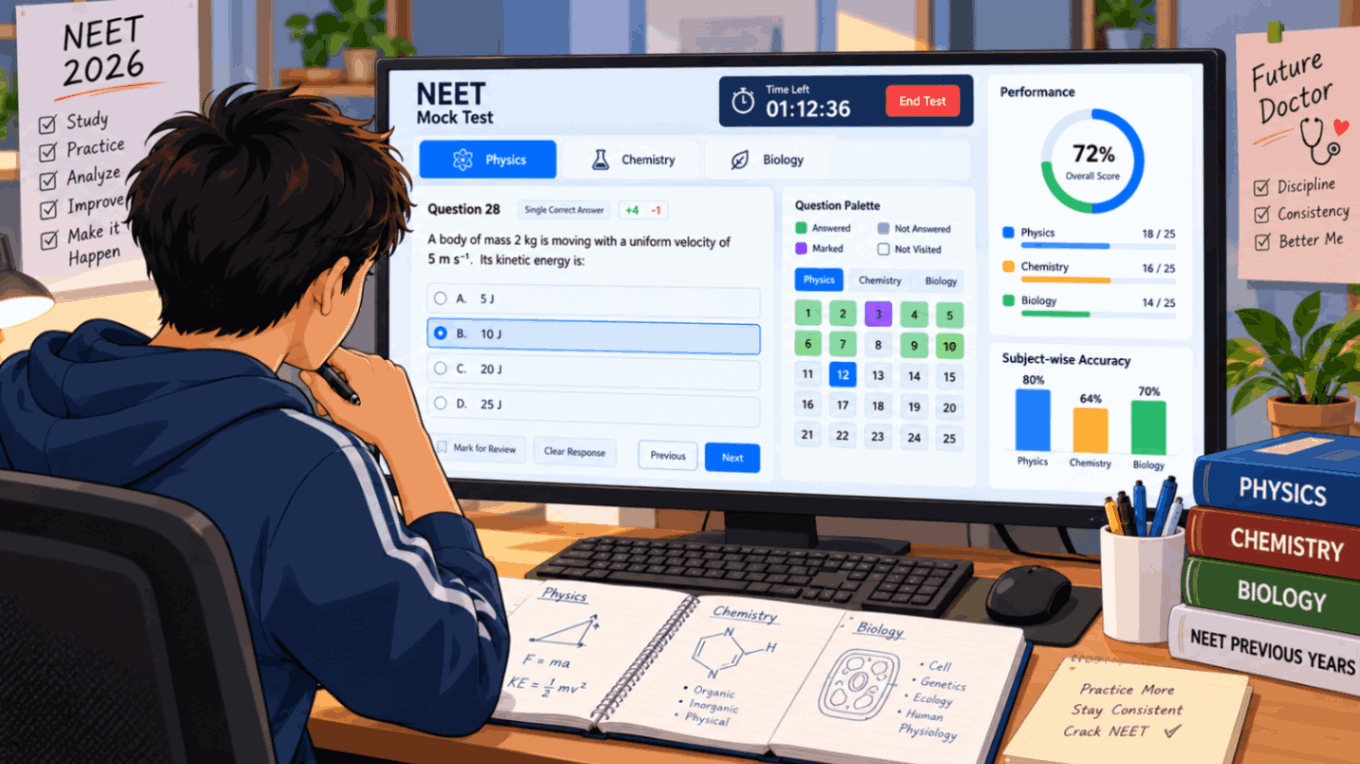
NEET Test Series 2027 with Real CBT Exam Practice
Preparing for a medical entrance examination requires more than completing the syllabus. Students must also learn how to apply concepts under time pressure, avoid careless errors and maintain concentration throughout a test.
A structured NEET test series can help students develop these skills. Regular mock tests reveal whether you understand a topic well enough to solve unfamiliar questions. They also show where you lose marks because of poor time management or rushed decisions.
For 2027 aspirants, computer-based test practice can offer additional familiarity with digital interfaces. However, candidates should verify the official examination mode through NTA rather than assuming CBT has been confirmed.
Why Mock Tests Matter During NEET Preparation
Many students feel confident after finishing a chapter. Yet, their performance can change when questions appear in a mixed paper with a running timer.
This happens because learning and applying knowledge are different skills. A mock test brings both together.
Regular tests help you:
-
Identify weak chapters before the final revision period.
-
Improve speed without sacrificing accuracy.
-
Practise switching between Physics, Chemistry and Biology.
-
Build concentration during longer examinations.
-
Recognise recurring mistakes and correct them.
-
Track progress using actual test scores.
Moreover, mock tests help students replace guesswork with evidence. Instead of saying, “I think my Physics is weak,” you can identify the chapters and question types causing difficulty.
The goal is not to achieve a perfect score in every practice test. The goal is to improve steadily and understand why each mistake happened.
What Makes a NEET Test Series Useful?
Not every collection of MCQs provides the same preparation value. A useful test series should follow a planned structure and help students measure their progress.
Full-Length Mock Tests
Full-length tests help you practise the complete paper under timed conditions. They are particularly useful after completing a substantial portion of the syllabus.
Try to recreate examination conditions. Keep your phone away, avoid interruptions and do not pause the timer unnecessarily.
Chapter-Wise Tests
Chapter tests help you check individual concepts immediately after studying them. They are useful during the learning phase because mistakes remain easier to identify.
For example, after studying Current Electricity, attempt a focused test before moving to another Physics chapter.
Subject-Wise Tests
These tests focus on Physics, Chemistry or Biology separately. They help students identify subject-specific weaknesses without the pressure of switching between all three subjects.
Mixed-Syllabus Tests
Mixed tests combine topics from different chapters. They assess whether you can recognise the correct concept without knowing the chapter name in advance.
A balanced test series should include all these formats as preparation progresses.
Real CBT Exam Practice: What Should Students Expect?
Computer-based test practice allows students to answer questions using a digital interface. Depending on the platform, the interface may include question navigation, answer selection, review markers and a countdown timer.
These features can help students become comfortable with digital testing. However, a practice platform should not claim to reproduce the official NEET interface unless that similarity is verified.
For NEET 2027, the actual examination mode and instructions must come from the official notification.
Until then, digital mock tests can still help improve general skills such as screen reading, concentration and timed decision-making.
Students should also continue solving questions on paper when necessary, especially for Physics calculations and rough work. The underlying concepts remain more important than the device used for practice.
NEET Test Series 2027: Types of Tests to Practise
Choosing the right test at the right stage can make preparation more organised.
Students do not need to attempt every test type daily. Choose according to your current syllabus coverage and revision needs.
How to Analyse Your Mock Test Results
Taking a test is only half the work. The real improvement often happens after you submit it.
Start by reviewing incorrect and unanswered questions. Then classify each mistake according to its cause.
Conceptual error: You did not understand the underlying idea.
Memory error: You forgot a fact, formula or reaction.
Calculation error: Your method was correct, but the arithmetic went wrong.
Reading error: You missed a word such as “incorrect,” “except” or “not.”
Time-management error: You spent too long on one question or rushed through others.
Create a mistake notebook with the question topic, error type and correct approach. Revisit it during weekly revision.
Also, compare your performance across several tests rather than judging your preparation from one score. A single paper may be unusually easy or difficult.
Subject-Wise Strategy for Better Mock Test Scores
Every subject requires a slightly different approach. Your test analysis should reflect these differences.
Physics: Improve Accuracy and Calculation Speed
Physics questions often require concept application, calculations and careful reading.
To improve performance:
-
Revise formulas regularly.
-
Practise numerical questions under time limits.
-
Write units during calculations.
-
Identify the given values before selecting a formula.
-
Reattempt incorrect questions without viewing the solution first.
If you repeatedly struggle with a particular chapter, revise its concepts before taking another large test.
Chemistry: Combine Memory With Understanding
Chemistry includes numerical problems, reaction-based questions and factual knowledge.
Physical Chemistry benefits from regular calculations. Organic Chemistry requires a clear understanding of reactions and concepts. Inorganic Chemistry needs careful revision of relevant textbook material.
After every test, identify whether mistakes came from forgotten information or weak understanding. The remedy depends on the cause.
Biology: Strengthen Recall and Reading Accuracy
Biology questions may test detailed knowledge and subtle differences between statements.
Read NCERT carefully and practise questions from completed chapters. Pay attention to diagrams, tables, definitions and examples.
During tests, read every option before selecting an answer. Avoid choosing an option simply because it sounds familiar.
How Often Should You Take Mock Tests?
The ideal frequency depends on your syllabus coverage, available time and current performance.
During the early learning phase, chapter tests and short quizzes may be more useful than frequent full-length papers. Once you have covered a substantial part of the syllabus, introduce mixed tests and longer mocks.
A practical progression looks like this:
-
Early preparation: Take chapter tests after studying each topic.
-
Middle preparation: Add subject-wise and part-syllabus tests.
-
Advanced preparation: Schedule regular full-length mocks.
-
Final revision: Practise timed papers and review recurring mistakes.
Avoid taking so many tests that you have no time left to revise them. One carefully analysed test can be more useful than several attempts without review.
A Weekly Mock Test and Revision Plan
A weekly routine can help you balance learning and assessment.
-
Monday: Revise a weak Physics chapter and attempt a short test.
-
Tuesday: Practise Chemistry MCQs and review incorrect answers.
-
Wednesday: Take a Biology chapter test.
-
Thursday: Revise topics from earlier weeks.
-
Friday: Attempt a mixed-subject practice paper.
-
Saturday: Take a longer mock test according to your preparation stage.
-
Sunday: Analyse mistakes and prepare the next week's targets.
Adjust this plan around school, coaching and other commitments. Consistency matters more than following an unrealistic timetable.
Common Mistakes to Avoid in a Test Series
Even serious students can waste the benefits of mock tests through poor habits.
Avoid these mistakes:
-
Checking your score without reviewing answers.
-
Repeating the same test without understanding errors.
-
Comparing every result with another student's marks.
-
Guessing randomly to increase attempts.
-
Ignoring chapters that repeatedly cause problems.
-
Taking full-length tests before building sufficient syllabus knowledge.
-
Changing your entire study plan after one disappointing result.
Instead, use each result as feedback. A lower score can still be valuable when it identifies exactly what needs improvement.
How to Choose a Suitable NEET Test Series
Before selecting a programme, look beyond the number of tests advertised.
Check whether the programme offers:
-
Questions aligned with the current official syllabus.
-
Chapter-wise and full-length practice.
-
Timed test conditions.
-
Clear explanations for answers.
-
Performance analysis and progress tracking.
-
Regular opportunities to discuss doubts.
-
A schedule that fits your preparation level.
If you plan to practise digitally, check whether the platform works reliably on your device. Make sure you understand how to navigate questions and review your responses.
Also, avoid relying on claims about guaranteed ranks or guaranteed scores. Results depend on your preparation, consistency and performance on examination day.
Official Updates and Useful Preparation Resources
Students should verify the latest syllabus and examination instructions through official sources. The National Testing Agency publishes examination-related notices, while the National Medical Commission provides information related to medical education and syllabus decisions.
Conclusion
A well-planned NEET test series helps students turn preparation into measurable progress. Chapter tests reveal concept gaps, subject-wise papers strengthen individual subjects, and full-length mocks develop stamina and time management.
For NEET 2027, combine regular testing with NCERT revision, careful mistake analysis and realistic study targets. CBT-style practice can also build digital confidence, but students should confirm the official examination format before making major changes to their routine.
Remember, the purpose of a mock test is not simply to produce a score. It is to help you understand your current level, correct weaknesses and perform more confidently next time.