
Facing the final month before JEE Main 2026 can feel overwhelming, but a clear 30-day revision strategy turns panic into steady progress. This plan prioritises high-yield topics, timed mock practice, and daily checklists so you can improve accuracy without burning out. Read on for a calm, actionable roadmap you can start today and adapt to your strengths.
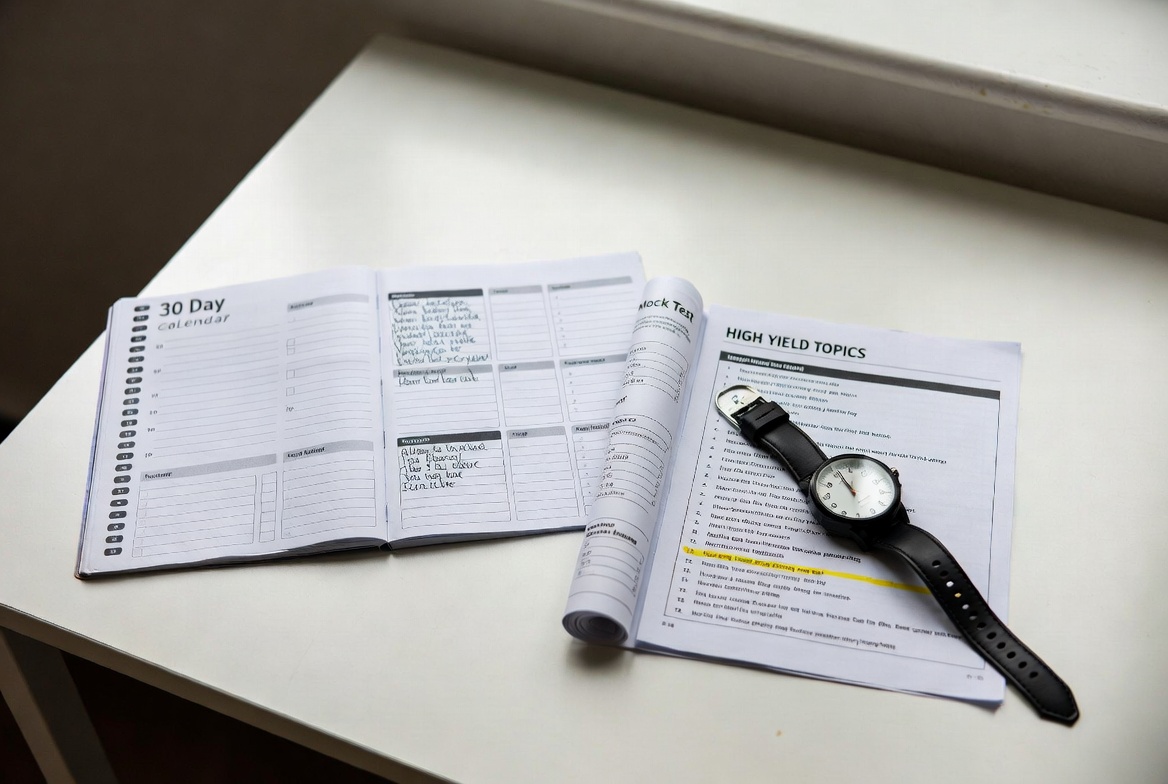
Why a focused 30-day plan beats random revision
When only a month remains, scattered studying wastes time. A structured 30-day plan forces prioritisation. Moreover, it converts weak areas into stable scoring regions through repeated, scheduled practice. Therefore, follow a daily routine that balances content revision, problem practice, and timed mocks.
How to assess where you stand on day 1
Start by taking one full-length timed mock. Then:
-
Record scores and sectional times.
-
Note 10 recurring error types (calculation, concept, silly mistakes).
-
Rank weak topics by frequency and impact.
This quick audit sets realistic targets for the month.
Week-by-week breakdown (overview)
-
Week 1: Consolidate high-yield topics and clear basics.
-
Week 2: Target problem patterns; start sectional timed tests.
-
Week 3: Increase full-length mocks and speed work.
-
Week 4: Polishing, light revision, and mental prep.
High-yield topics to prioritise (subject-wise)
-
Physics: Mechanics, Electricity, Modern Physics.
-
Chemistry: Physical concepts, Organic reaction mechanisms, Inorganic NCERT facts.
-
Mathematics: Calculus, Algebra (Sequences & Series), Coordinate Geometry.
Focus on topics that consistently yield 10–20 marks per paper.
Daily schedule template (sample)
-
Morning (2–3 hours): Concept revision + one short practice set.
-
Midday (1–2 hours): Problem-solving — targeted topic.
-
Evening (2–3 hours): Timed sectional or full-length mock practice.
-
Night (30–45 mins): Quick revision of one-page notes and flashcards.
Keep breaks and 6–7 hours of sleep—quality rest aids memory.
Time vs. Gain: comparison table for focus areas
| Focus Area | Daily Time | Expected Weekly Gain |
|---|---|---|
| High-yield Topics | 3–4 hours | 8–12 marks |
| Mixed Problem Practice | 1.5–2 hours | 6–10 marks |
| Timed Mocks & Analysis | 2–3 hours (on mock days) | 10–15 marks |
Week 1 — Build a strong base
-
Revisit core formulas and derivations.
-
Create one-page summaries for each high-yield chapter.
-
Solve 20–30 focused problems daily on those chapters.
Tip: Active recall beats passive reading, so quiz yourself.
Week 2 — Pattern identification & sectional strength
-
Begin timed sectional tests (45–60 minutes each).
-
Analyze frequent mistake types and note them in an error log.
-
Convert every mistake into a 3-line correction note.
This helps prevent repeat errors under exam pressure.
Week 3 — Full-length mocks and stamina
-
Increase mock frequency to 2 per week.
-
Simulate exam conditions (same time, no phone).
-
After each mock, spend equal time on analysis as on taking it.
Moreover, practise quick elimination techniques for MCQs.
Week 4 — Polishing and strategy tuning
-
Reduce new learning. Focus on revision, quick notes, and light mocks.
-
Practice time management: 20–25 minutes per section is flexible—adapt to your strengths.
-
Visualise exam day: entry, invigilation, and calm start.
Mock strategy that actually improves score
-
Take mock under strict time.
-
Mark questions you guessed vs. knew.
-
Analyze: 50% time should be spent on solving, 50% on understanding mistakes.
-
Re-solve wrong problems after two days.
Checklist for exam week
-
Pack permitted items a day before.
-
Keep NCERT one-liner notes and formula sheets.
-
Sleep early; avoid heavy revision on the final night.
-
Eat balanced meals and hydrate.
Simple tools to track progress
-
Mistake Log: topic, error, fix.
-
One-page summary for each chapter.
-
Weekly score tracker (mock vs. target).
Use phone reminders for micro-revisions.
Quick drills to regain accuracy
-
10-minute mental maths drill daily.
-
20 MCQ rapid-fire sessions for elimination practice.
-
Flashcard recall of 30 formulas each morning.
When to skip: stop new topics and why
Stop learning new chapters in the last 10–12 days. New topics create uncertainty and lower confidence. Instead, consolidate what you know and sharpen test technique.
Stress management and mental prep
-
Short breathing exercises before study.
-
Keep one leisure slot daily (30–60 mins).
-
Reframe anxiety as excitement; small wins compound confidence.
Realistic expectations and target setting
Set weekly micro-goals: +5 marks in Physics, consistent 80% accuracy in a section, etc. Celebrate small improvements. This keeps motivation genuine.
Conclusion
In the final 30 days before JEE Main 2026, deliberate practice beats last-minute cramming. Prioritise high-yield topics, run frequent timed mocks, and keep a strict error-log. Moreover, maintain sleep and stress-control routines. Follow the week-by-week plan above, adapt it to your weaknesses, and you'll convert effort into measurable score improvements.